








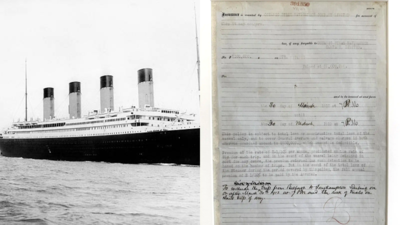
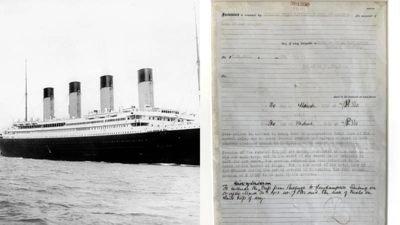
More than a century after the Titanic sank in the North Atlantic, an unusual piece of paperwork connected to the doomed liner’s final voyage has resurfaced. An original insurance document linked to the ship’s $5 million total-loss cover, arranged just weeks before the disaster, is set to go under the hammer in Britain, with an estimated price of up to $67,000. The document is being offered by British auction house Henry Aldridge and Son at its November 21 auction in Devizes, England. It carries an estimate of £30,000 to £50,000, equivalent to approximately $40,000 to $67,000.The document is particularly striking because it records insurance protection for a ship that was widely believed to be virtually unsinkable, yet disappeared beneath the Atlantic less than a month after the policy took effect. Its most remarkable detail, however, is what happened after the disaster: Titanic’s owners received the full insurance payout within 30 days of the sinking, even as families of those who died faced a much longer wait for compensation.
Just weeks before the Titanic disaster
The insurance arrangement was taken out by the Oceanic Steam Navigation Company, the parent company of the White Star Line, which operated Titanic. According to the auction description and reports by PEOPLE, the ship was covered for a total loss of $5 million through an arrangement involving 77 insurers. One of the major participants was Atlantic Mutual Insurance Company, which covered $100,000 of the risk. The resurfaced document comes from Atlantic Mutual’s archives and records its individual share of the wider insurance arrangement. It should not be confused with a single policy showing that Atlantic Mutual alone insured the entire ship for $5 million.The document was signed on March 27, 1912, with coverage taking effect on March 30 at 7 pm and continuing until March 30, 1913. It also contains a handwritten addition extending protection to Titanic’s journey from Belfast to Southampton and the risk associated with its sea trials. The timing makes the document particularly significant. Titanic departed Southampton on April 10, 1912, on its maiden voyage to New York. Four days later, on the night of April 14, it struck an iceberg in the North Atlantic. The ship sank in the early hours of April 15, killing approximately 1,500 people.The insurance settlement was completed far more quickly than many might expect following a disaster of such scale. Lloyd’s, which had arranged more than £1 million in hull insurance for Titanic, confirms in its historical records that insurers paid the claims in full within 30 days. Lloyd’s records show that the ship’s hull alone was insured for £1 million. The risk was distributed among several companies and more than 50 Lloyd’s syndicates, with individual participants taking different portions of the cover. The premium for the hull insurance was £7,500.The $5 million total-loss cover reported in connection with the resurfaced Atlantic Mutual document was part of the wider insurance arrangement. The auction house says the limits of Atlantic Mutual’s policy were also paid within 30 days of the sinking.
Families waited years for compensation
Auctioneer Andrew Aldridge told PEOPLE that it was extraordinary that the owners received their payout within a month of the disaster, when the funerals of many victims had barely taken place. He also described the words “total loss” in the document as particularly striking given how soon after the policy was issued the ship was destroyed.According to Aldridge, families who pursued negligence claims had to wait four years for compensation, eventually receiving a combined total of $663,000. His comparison highlights the difference between the insurance arrangements protecting the vessel’s owners and the lengthy process faced by people seeking compensation for the human losses.Titanic carried 2,224 passengers and crew. It had only 20 lifeboats, with capacity for 1,178 people. Lloyd’s historical account records that 1,514 people perished, making the sinking one of the deadliest peacetime maritime disasters.The ship’s loss also became a major event in the history of marine insurance. Lloyd’s records describe how news of the sinking initially arrived through wireless telegraphy, with conflicting reports circulating for days. Some newspapers even believed the ship had survived and was being towed to Halifax.
How the 114-year-old document resurfaced
The insurance document remained among the historical records of Atlantic Mutual, a US insurer founded in 1838. The company was eventually placed into liquidation in 2011 after suffering financial difficulties, including losses connected to claims arising from the September 11, 2001 attacks.Following its liquidation, historical material from its archives was included in an exhibition in New York. A dealer subsequently purchased the Titanic insurance document, according to the auction house and PEOPLE.Aldridge said the auction house had been unable to locate another surviving original insurance document relating to Titanic and described the item as unique to its knowledge. The estimate of up to £50,000 reflects its rarity and its connection to one of the most famous maritime disasters in history.The insurance document will not be the only Titanic-related artefact offered at the November 21 sale. Original shipbuilding plans used by Harland and Wolff, the Belfast company that constructed the liner, are also due to be auctioned.