








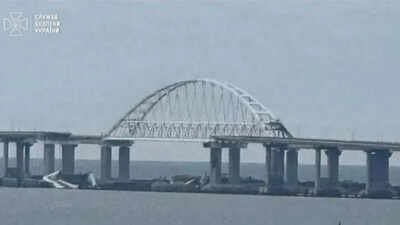
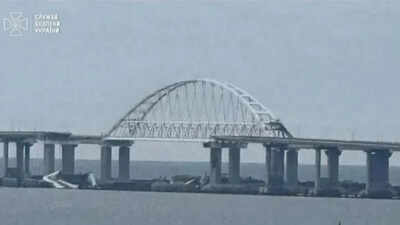
Russia’s most prized bridge to Crimea has once again come under attack, but this time Ukraine appears to have thrown an entire arsenal at it.In a carefully planned, seven-stage operation spanning several weeks, Kyiv deployed 11 different drones and missile systems, first targeting Russian air defences and radar installations before striking the strategically vital Kerch Bridge, according to Ukrainian officials and a report by The War Zone (TWZ).Ukrainian President Volodymyr Zelenskyy said on November 17 that the operation was coordinated by the Security Service of Ukraine (SBU) and the General Staff of the Armed Forces. He said Ukrainian forces systematically weakened Russia’s defences before launching the final assault, which caused a major collapse in the bridge’s road section and damaged its railway infrastructure.The assault involved multiple weapons with different ranges, flight profiles and capabilities, allowing Ukraine to mount a complex attack against the bridge.Zelenskyy said Palianytsia missile-drones struck the road section, while Neptune, Ruta and FP-5 Flamingo systems were used against the railway section. He also highlighted the use of communication links to maintain control of the Flamingo missile until the final moments of its flight.From Dovbush to Flamingo, the 11 weapons Ukraine deployedUkrainian President Volodymyr Zelenskyy identified 11 weapons systems used during the operation. The arsenal included reconnaissance drones, one-way attack drones, jet-powered missile-drones and cruise missiles.While Ukraine has disclosed the weapons involved, their individual targets and roles during the first six stages have not been fully established.The Dovbush is a Ukrainian-developed drone family used for reconnaissance and strike missions, with some variants capable of carrying smaller FPV drones. The Vendetta, another Ukrainian system, is an FPV attack drone reportedly equipped with thermal imaging for night operations. Both could support attacks against military installations, although their specific roles in the Kerch Bridge operation have not been disclosed.The Da Vinci, developed by Netherlands-based defence company Destinus, is a propeller-driven, long-range one-way attack drone designed to carry explosive payloads deep into enemy territory. The Sichen and MICH-2000 are also long-range Ukrainian attack drones, reportedly capable of travelling around 1,400 km and 2,000 km respectively. Both are designed for deep-strike missions against targets far behind enemy lines.The Ruta, another Destinus-developed weapon supplied to Ukraine, is a low-cost cruise missile. Its manufacturer claims a range of around 300 km and a payload capacity of up to 150 kg. The Palianytsia, meanwhile, is a Ukrainian-developed, turbojet-powered missile-drone designed for long-range strikes. Zelenskyy specifically credited Palianytsia with hitting the bridge’s road section.The An-197 is identified by Ukrainian defence publication Militarnyi as a jet-powered version of the Liutyi long-range attack drone. The FP-1, developed by Ukrainian company Fire Point, is another one-way attack drone designed to strike military and infrastructure targets deep inside enemy territory.Among the heavier weapons were the FP-5 Flamingo, a ground-launched cruise missile whose manufacturer advertises a range of around 3,000 km and a warhead weighing up to 1,200 kg, and the R-360 Neptune, originally developed as an anti-ship missile and later adapted for land-attack missions.The Neptune gained prominence in 2022 when Ukraine used it to sink Russia’s Black Sea Fleet flagship Moskva. Zelensky identified both systems among the weapons deployed against the Kerch Bridge’s railway section.Why the Kerch Bridge is strategically important for RussiaThe 19-km Kerch Bridge, also known as the Crimean Bridge, connects Russia’s Krasnodar region with the Crimean Peninsula across the Kerch Strait. Opened in 2018, it carries road and railway traffic and provides Russia with a direct transport link to Crimea without passing through mainland Ukrainian territory.The bridge has been an important military supply route for Moscow, particularly since its full-scale invasion of Ukraine in 2022. It has been used to transport Russian troops, military equipment, fuel, ammunition and other supplies to Crimea and Russian forces operating in southern Ukraine.Its disruption forces Moscow to rely more heavily on alternative supply routes through occupied Ukrainian territory, including the land corridor connecting Russia with Crimea through the Sea of Azov region.Beyond its military importance, the bridge also serves as a crucial civilian connection, carrying food, fuel and other essential supplies to Crimean cities such as Sevastopol, Simferopol and Yalta. It is therefore important for sustaining both the peninsula’s population and its economy.The crossing also carries considerable political significance for Russian President Vladimir Putin. Built after Moscow’s 2014 annexation of Crimea, it became a symbol of Russia’s claim over the peninsula. Putin personally inaugurated its road section in May 2018 by driving a truck across it.For Ukraine, the bridge represents a visible symbol of Russia’s occupation of Crimea and a key link supporting Moscow’s military presence there.