







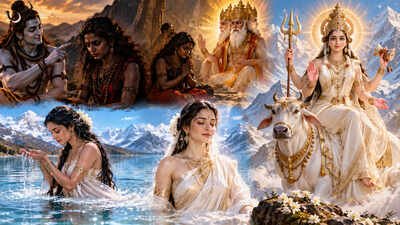
“Kali.” Shiva said it teasingly, but the remark hurt Parvati deeply. She had just taken the fierce form of Kaalratri, and her body had darkened with that intensity. One teasing word, and she was deeply saddened.This is the popular telling, handed down through the katha tradition, though details differ between versions. In this account, Parvati leaves Shiva and spends an age worshipping Lord Brahma. The length of her penance says something true about how far the mind can travel when it clings to a wound, even one that began with a joke.
One Instruction from Brahma
When Brahma appears, he does not offer a long discourse. He gives her one clear instruction: bathe in Lake Mansarovar.
What Happened at the Water’s Edge
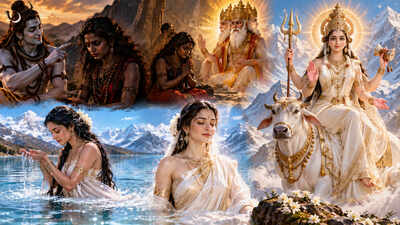
She does as instructed. As she emerges from the lake, her form changes. She is now as white as milk and the moon, and this radiance is why she is known as Mahagauri.The same being who darkened with fierce power now stands luminous. On the surface, it is a story of bathing and transformation. Beneath that, it speaks of what can change a life—not just the outer form, but also the inner burden that clings to it.
Fight Fully, Then Wash the Mind
Devotional teaching draws two lessons from this episode, and the second is harder than the first. When a serious problem arises, meet it with all your strength. Half-measures do not work when the problem is serious. But once the battle is over, do not carry bitterness or painful memories within you. The battle ends outside, but for many people, it continues within.Mansarovar can be understood as the lake of the mind. Bathe there, wash away the negativity, and return to enjoying life as you normally would. What is the point of victory if the mind keeps its scars fresh?Ashtami, which falls on Monday, 19 October 2026, is one of the most important days of Navratri. Mahagauri represents purity, peace, clarity, and gentleness—the calm that follows Kaalratri’s night.
The Bull, the Trident, and the Open Hand
Mahagauri rides Vrishabha, the bull, which represents stability. She rode a bull as Shailputri, too. Having destroyed the negative forces, she has regained that steadiness. Stability is not accidental; it is reclaimed.She has four arms. One right hand is raised in Abhaya Mudra, the gesture of fearlessness, while the other holds a trident. One left hand holds a damaru, a small hand drum, while the other rests in Varada Mudra, the gesture of granting boons.If you want a line to carry with you, let it be a simple prayer:“Mother, purify my thoughts, calm my mind, and bless me with wisdom.”