







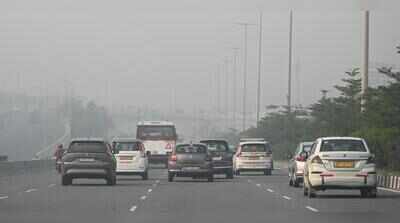
Patna: With fireworks expected to push up pollution levels during Diwali, the Bihar State Pollution Control Board (BSPCB) has put in place a temporary monitoring network at strategic locations across Patna to track the festival’s impact on air quality and noise levels.The board will compare the readings recorded during the festival with pollution levels before and after Diwali to assess how much air and noise pollution rises during the celebrations.While air quality will be monitored round the clock, manual noise monitoring at the temporary locations will be carried out for six hours, from 6pm to midnight.Temporary monitoring arrangements have been made at four locations — Boring Road crossing near Krishna Agency, Beltron Bhawan in Shastri Nagar, Parivesh Bhawan in the industrial area and the Geological Survey of India office in Kankarbagh. At these locations, officials will manually record noise levels, while air-quality measurements will also be taken at the designated sites.The air monitoring will focus on key pollutants including PM10 (particulate matter with a diameter of 10 micrometers), PM2.5 (particulate matter with a diameter of 2.5 micrometers or smaller), Sulfur dioxide (SO₂) and nitrogen oxides (NOx), allowing the board to track the changes in particulate pollution and gaseous pollutants during the festival period.The air-quality monitoring will continue round the clock, while manual noise monitoring will be conducted from 6pm to midnight.According to Board officials, the temporary monitoring exercise will be carried out from Nov 1 to Nov 15, covering the period pre and post- Diwali. This will help the pollution control board establish a comparative picture rather than relying only on the readings recorded on the festival night, the officials added.The BSPCB will also use data from its permanent monitoring stations across the city. Continuous air-quality monitoring stations are located at key locations including the DRM office campus in Khagaul, Patna City, S K Memorial Hall, Planetarium, Eco Park and Samanpura.Noise pollution is also being monitored at a number of permanent locations in Patna, including the Chanakya National Law University campus, DRM office, Rajkiya Mahila Mahavidyalaya at Gulzarbagh, Patna Dairy Project, the BDO office in Kumhrar, ITI Digha, the BSPCB air laboratory, Urja Auditorium and IGIMS.The permissible noise limits vary according to the classification of an area. In industrial areas, the prescribed limit is 75 decibels during the daytime and 70 decibels at night. For commercial areas, the limits are 65 decibels during the day and 55 decibels at night. Residential areas have lower limits of 55 decibels during the day and 45 decibels at night, while silence zones have limits of 50 decibels during the day and 40 decibels at night.