





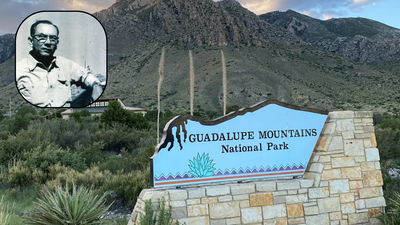
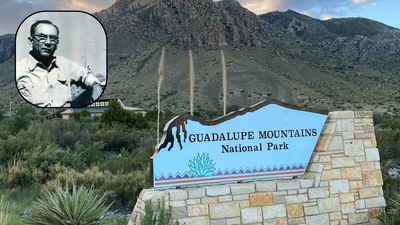
What if a piece of land offered to the government for $237,600 had been bought then? The answer might have changed the history of the Guadalupe Mountains by decades. In 1934, Texas rancher J.C. Hunter offered 43,200 acres to the US government, hoping the spectacular mountain country could be protected. The offer went nowhere. More than three decades later, his son, J.C. Hunter Jr., sold the family land to the federal government; this time, 72,071 acres for $1.5 million. According to the National Park Service, the later acquisition accounted for more than 90% of the land that became Guadalupe Mountains National Park.
When the mountains were still ranch country
The Guadalupe Mountains were a very different place in the early 20th century. There was no national park, no network of trails and no stream of visitors arriving to explore the landscape. Much of the area was privately owned ranch land. J.C. Hunter, a rancher from Van Horn, Texas, became particularly interested in the mountains. He had visited McKittrick Canyon and developed an appreciation for the area. At the same time, he was expanding his ranching interests in the region.During the 1920s and 1930s, Hunter put together several smaller ranches, creating what became known as the Guadalupe Mountain Ranch. Sheep and goats were raised on the property, and Hunter worked to provide water for livestock in the higher parts of the ranch. Yet he did not see the mountains only as grazing land. He was also interested in the possibility of protecting them for the future.
A major offer came in 1934
Hunter’s idea took a concrete form in 1934. That year, he offered 43,200 acres to the federal government for $237,600, according to the National Park Service. The property was owned by the Grisham-Hunter Corporation, and the price was based on what the corporation had paid for the land. There was some support for the idea of protecting the area. Roger W. Toll, then superintendent of Yellowstone National Park, had visited the Guadalupe Mountains and discussed the possibility of creating a national park with Hunter. But several things stood in the way.The federal government was not prepared at that time to spend large amounts of money acquiring privately owned land for a new park. The Guadalupe Mountains were also remote, and there was little infrastructure in the area. So Hunter’s offer did not result in a park. For the next several decades, the mountains remained part of a working ranch landscape.
The ranch passed to J.C. Hunter Jr.
When J.C. Hunter died in 1945, the property passed to his son, J.C. Hunter Jr. The younger Hunter continued to expand the ranch. Eventually, the family property covered 72,071 acres. He also retained his father’s interest in the mountains and their possible future as protected land. The ranch continued to operate as a ranch, with livestock and wildlife sharing the property. Hunter Jr. also enjoyed the recreational side of the land and welcomed friends to the ranch.Owning tens of thousands of acres, however, came with its own problems. Hunter Jr. was also concerned about the financial burden that could fall on his family, including taxes. Selling the ranch to the government became a possibility again.
The second offer was much bigger
By 1966, efforts to acquire Hunter Jr.’s property for the federal government had gained more momentum. This time, the circumstances were different. The idea of creating a national park in the Guadalupe Mountains had gained much more momentum, and the federal government was interested in acquiring the land needed to make it happen. The deal was eventually completed in December 1969. The government bought 72,071 acres from Hunter Jr. for $1.5 million, according to the National Park Service.The figures are striking when placed next to his father’s earlier offer. In 1934, J.C. Hunter had offered 43,200 acres for $237,600. Thirty-five years later, his son sold a larger tract for $1.5 million. More importantly, the purchase supplied more than 90% of the land assembled for Guadalupe Mountains National Park.
The Hunters were not the only ones involved
The park’s creation was not the work of the Hunter family alone. Wallace Pratt, a petroleum geologist, had become closely associated with McKittrick Canyon. He eventually donated nearly 6,000 acres there to the federal government, adding another important piece to the effort to preserve the Guadalupe Mountains.Congress authorised Guadalupe Mountains National Park in 1966. The Hunter land purchase followed, and the National Park Service continued putting the pieces together. The park was dedicated and opened to the public in September 1972.
A working ranch leaves its mark
Today, visitors know Guadalupe Mountains National Park for its rugged peaks, canyons and desert scenery. But the landscape also carries the history of the ranchers who once owned and worked it. Places such as Frijole Ranch and Williams Ranch preserve pieces of that past. The Hunter family’s role stands out because its story unfolded over generations. J.C. Hunter saw the possibility of protecting the mountains in the 1930s. His son eventually helped turn that possibility into a national park.What Hunter could not accomplish with his $237,600 offer in 1934 was ultimately achieved through a much larger transaction decades later: 72,071 acres changing hands for $1.5 million and becoming the foundation of one of Texas’s most distinctive national parks.