







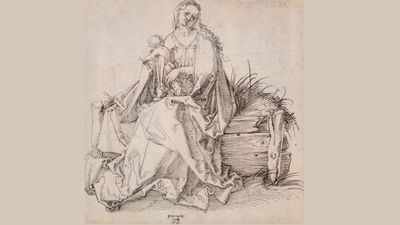
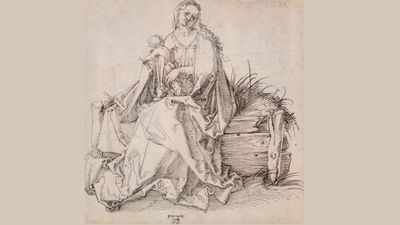
A $30 estate-sale purchase in Massachusetts has turned into one of the most remarkable art discoveries of recent years. The small, unframed drawing, bought by an anonymous man in 2017, has been identified by leading scholars as an original work by German Renaissance master Albrecht Dürer. Now titled ‘The Virgin and Child With a Flower on a Grassy Bench’ and dated to 1503, the ink sketch is believed to be worth at least $10 million, with some estimates placing its value far higher. The news was reported by NPR, Smithsonian Magazine and Artnet News. Read more about it here:
A bargain no one expected
The buyer came across the drawing at an estate sale in Massachusetts, where it was displayed without a frame and priced at just $30. It showed a mother and child rendered in delicate ink on yellowed linen, and although it carried Dürer’s well-known “A.D.” monogram, neither the seller nor the buyer believed it was a genuine Renaissance work.The anonymous purchaser later said he bought it simply because he thought it was “a wonderfully rendered piece of old art,” as per the reports. He kept it at home, unaware that the modest sheet of paper might be an original drawing by one of the most important artists of the Northern Renaissance.The work had been sold by the daughters of the late architect Jean-Paul Carlhian. Their family had long assumed it was a modern reproduction, though its history appears to reach back to 19th-century French art collectors among the Carlhian ancestors.
From curiosity to masterpiece
According to Smithsonian Magazine, the turning point came in 2019, when art collector and Agnews Gallery shareholder Clifford Schorer heard rumours about the possible Dürer during a trip to Boston. After seeing the drawing, he described the moment as extraordinary, saying it was either the greatest forgery he had ever seen or a masterpiece.Experts then spent years examining the work. Their investigation focused on the materials, the monogram, the paper and the drawing’s relationship to Dürer’s known compositions. The verification process ultimately took about three years before scholars became confident that the sketch was authentic.Two details proved especially persuasive. First, Dürer had inscribed his initials using the same ink as the drawing itself, a practice seen on at least 20 other works made between 1501 and 1514. Second, paper conservator Jane McAusland identified a trident and ring watermark on the sheet, a motif found on more than 200 sheets known to have been used by the artist.
Scholars confirm the attribution
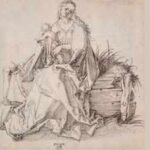
Leading Dürer specialists Christof Metzger, head curator at Vienna’s Albertina Museum, and Giulia Bartrum, formerly a curator at the British Museum, examined the drawing and judged it authentic, reports shared. Their assessment transformed what had been treated as an attractive old sketch into a newly recognised work by a Renaissance master.The drawing is now dated to 1503 and titled The Virgin and Child With a Flower on a Grassy Bench. Scholars believe Dürer created it as a preparatory study for ‘The Virgin Among a Multitude of Animals’, a separate composition held by the Albertina Museum in Vienna.The image depicts the Virgin Mary seated with the Christ child on a grassy bench beside a simple wooden fence. Dürer gave the scene an unusually lively quality by showing Jesus as a squirming toddler rather than a calm infant, twisting away from the viewer and turning his attention toward his mother.
Why it could be worth millions
When the discovery became public in 2022, NPR reported that the drawing was believed to be worth around $10 million. Smithsonian Magazine later noted that experts suggested it could be worth upward of $50 million, reflecting both Dürer’s stature and the rarity of a previously unknown work by the artist.The drawing was exhibited at Agnews Gallery in London, with plans for an eventual sale. Because Dürer works rarely appear on the market, and because this was the first completely unknown drawing by the artist to resurface since the 1970s, interest from major institutions and private collectors was expected to be intense.For the anonymous buyer, the discovery turned a casual $30 purchase into an extraordinary windfall. For the art world, it was a reminder that important works can survive unnoticed in attics, family collections and estate sales, waiting for someone with the knowledge to recognise them.
A lesson in looking closely
The story resonates because it combines luck, curiosity and expertise. The buyer did not set out to find a Dürer, but he recognised that the drawing had artistic quality and was worth investigating further. That instinct led to a process that connected a small sheet of paper to one of Europe’s greatest Renaissance artists.It also highlights the importance of provenance, materials and scholarly review. A signature alone is not enough to establish authenticity, but the matching ink, historic watermark and expert analysis together built a compelling case that this was no reproduction.More than five centuries after Dürer made the drawing, a $30 estate-sale find became a multimillion-dollar Renaissance treasure. It is a striking example of how art history can still surprise us, sometimes in the most ordinary places.