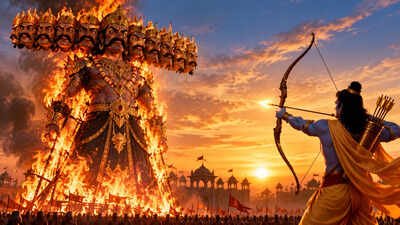








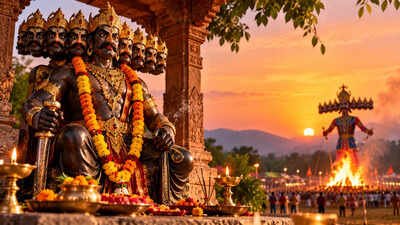
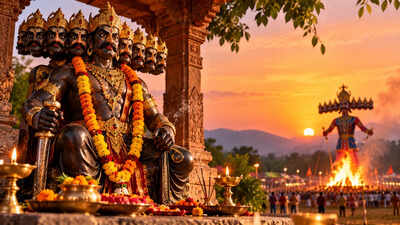
On the evening of 20 October, crowds in most Indian cities will gather around tall effigies of Ravana and cheer as they go up in flames. Yet in a handful of towns and villages, the same evening is quiet. Lamps are lit, prayers are offered, and in a few places people mourn.Dussehra 2026 falls on Tuesday, 20 October, and for these communities, Ravana is not a villain to be defeated. He is a scholar, a devotee, an ancestor or a son-in-law.
One Festival, Two Ways of Remembering
For most of the country, Vijayadashami marks the win of good over evil, and the burning of Ravana’s effigy is the loudest sign of it. Across the East, the same day recalls Goddess Durga’s victory over Mahishasura. Both traditions are old, and neither is challenged by the places listed below. Local beliefs simply focus on a different part of Ravana’s story: his learning, his devotion to Shiva and his family ties.
Bisrakh, Uttar Pradesh: The Birthplace
Bisrakh, a village near Greater Noida, is believed to be Ravana’s birthplace. Locals say he was born here to the sage Vishrava and Kaikesi, and the village temple is said to hold the Shiva Linga that Ravana and his father once worshipped. No effigy is burned. Instead, villagers perform prayers and yagnas during Navratri and mourn Ravana, whom many call a Maha Brahman, a great scholar.
Mandsaur, Madhya Pradesh: The Son-in-Law
Mandsaur is believed to be the home of Mandodari, Ravana’s wife. That makes Ravana the town’s son-in-law, and local customs follow that idea. A tall statue stands in the Khanpur area, and on Dussehra morning, people begin their prayers around 9:30 am. Many in the community honor him as an ancestor and a clan deity, and some switch off lights at home as a sign of respect.
Mandore and Jodhpur, Rajasthan: Family and Mourning
Mandore, near Jodhpur, is linked to the legend that Ravana married Mandodari there. Some Brahmin families in Jodhpur, such as the Dave-Godha Shrimali and Maudgil groups, consider themselves his descendants. They observe the annual shradh, a death ritual, on Dussehra, and they avoid watching his effigy burn. A temple dedicated to Ravana exists, and worship continues beyond the festival.
Kanpur, Uttar Pradesh: The Temple That Opens Once a Year
The Dashanan Temple in Kanpur’s Shivala area is among the best-known examples. Its doors stay shut for most of the year, then open only on Dussehra. The idol is decorated, and devotees pray to Ravana as a great devotee of Shiva and a master of the Vedas. Once the effigy burns in the evening, the doors close until the next Dussehra.
Ravangram, Vidisha, Madhya Pradesh: Ravan Baba
In Ravangram, villagers worship an ancient reclining statue of Ravana, around 10 feet long. They call him Ravan Baba, and many consider themselves his descendants. Burning an effigy would be unthinkable here. Instead, the village offers prayers for his peace.
Baijnath, Himachal Pradesh: A Devotee of Shiva
Baijnath in Kangra district is linked to Ravana’s penance in honor of Shiva. Locals believe that burning his effigy would anger the deity, so the town does not do it. The famous Kullu Dussehra, held nearby, also follows its own customs and does not feature a Ravana burning.
Other Places With a Ravana Connection
Kakinada in Andhra Pradesh has a temple dedicated to Ravana, tied to the idea that he chose the site to worship Shiva. In Karnataka’s Kolar district, Ravana is honored as a devoted Shiva follower. In Maharashtra’s Gadchiroli, a section of the Gond tribe remembers Ravana and his son Meghnad in their own festival traditions.
Why These Beliefs Exist
Four ideas appear again and again. The first is learning: Ravana is described in many texts as a scholar of the Vedas and a gifted musician. The second is devotion: his worship of Shiva is a central part of his story. The third is family: marriage ties explain why some towns treat him as a son-in-law. The fourth is ancestry, where clans trace their line back to him.Each community keeps a tradition that matches its local history, and many of them also attend Ramlila and respect the Rama story.
What It Says About Dussehra
India’s festivals carry many voices at once. A city may burn an effigy to remember a victory, while a village a few hours away mourns the same figure with prayers. The two practices can sit side by side because both are about meaning, not argument.For travelers, a Dussehra visit to one of these places offers a different view of the festival. The dates are the same, but the evening feels very different.