







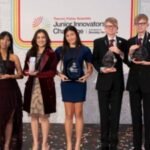
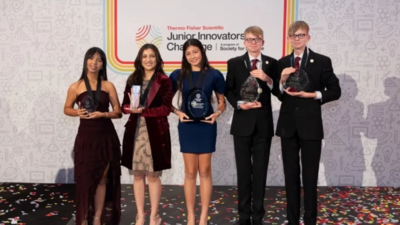
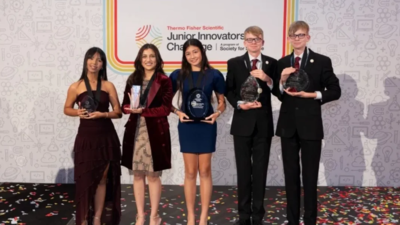
On October 27, Society for Science and Thermo Fisher Scientific named the winners of the Thermo Fisher Scientific Junior Innovators Challenge (Thermo Fisher JIC) at a ceremony in Washington, D.C. The top prize, the $25,000 Thermo Fisher Scientific ASCEND (Aspiring Scientists Cultivating Exciting New Discoveries) Award, went to Bailey Quinn Frank, 15, from Fort Lauderdale, Florida.“Middle school is where a spark of interest can become a lifelong passion for science,” said Maya Ajmera, president and chief executive officer (CEO) of Society for Science, in the organisation’s announcement.
What Bailey built
According to Society for Science, Bailey made a low-cost environmental DNA (eDNA) sampler that uses a small fan and filter paper to collect airborne bacteria. The fan pulls air through the paper, which holds on to what is in it.She sees the device as a way for rural communities to monitor possible health threats, the organisation said, particularly where limited resources make traditional disease surveillance hard.Ajmera pointed to the project in her statement. “Bailey’s research on using eDNA samplers to detect pathogens is a remarkable example of that spark in action,” she said, according to Society for Science.
The competition
The Thermo Fisher JIC is a programme of Society for Science and describes itself as the nation’s leading middle school science, technology, engineering and math (STEM) competition. Society for Science says it reaches 60,000 students a year through its Affiliated Fair Network.This year’s 30 finalists were picked from nearly 2,000 applicants from 47 states and five territories. Together they received more than $100,000 at the ceremony, and a panel of scientists, engineers and educators chose the winners. Each finalist’s school also received a $1,000 grant for STEM programming.
Team challenges
Finalists were not judged on their research projects alone. According to the announcement, each took part in team challenges built around project-based learning, designed to test critical thinking, communication, creativity and collaboration.The tasks were varied:
- Coding micro:bit processors to design sustainable cities
- Investigating an outbreak of several illnesses and deciding which patients to treat first
- Exploring how artificial intelligence (AI) could help scientists identify turtle species
- Designing and building protective enclosures for diamondback terrapin eggs
Ajmera congratulated Bailey and the other 2026 finalists. “Their talent and creativity give me great hope for the future,” she said, according to Society for Science.